


When Enforcement Freezes Resolution: Battle for Control Over Corporate Assets

Authors: Ram Sundar Singh Akela & Harshita
Fourth year law students, at National University of Study and Research in Law, Ranchi

I. Introduction
The collision between the Insolvency and Bankruptcy Code, 2016 ("IBC") and the Prevention of Money Laundering Act, 2002 ("PMLA"), is among the few conflicts that are consequential and often misunderstood. This discord renewed and reached a critical juncture in a recent judgment of the National Company Law Appellate Tribunal ("NCLAT"), i.e. Mr Anil Kohli v. Directorate of Enforcement ("Dunar Foods Case"), where the NCLAT’s interpretation of the nature and scope of Section 14 of the IBC calls for critical examination of the IBC’s moratorium provision.
At the core of this vortex lies a perplexed, simple question: Can the Enforcement Directorate ("ED") continue to attach the assets of the Corporate Debtor ("CD") under the PMLA, which is undergoing the Corporate Insolvency Resolution Process ("CIRP")? The IBBI's 2025 circular rules giving permission to the resolution professionals to pursue restitution proceedings for any assets attached under PMLA before the Special Court are viewed as a circumlocutory procedure that fails to clarify Section 14's definition of “proceedings”.
This article employs a three-stage framework to examine the validity of Provisional Attachment Orders ("PAOs") under PMLA: before commencement of CIRP, during CIRP, and after resolution or liquidation. This approach highlights the logical inconsistencies in the reasoning of NCLAT in the Dunar Foods case. The article addresses the resolution applicant’s uncertainty about whether key assets should remain accessible during the CIRP.
II. Misreading Moratorium: Fault Line in Insolvency Jurisprudence?
The Supreme Court has characterised PMLA as sui generis, and attachments operate in rem against the “proceeds of crime” rather than as a debt claim. Thus, a PAO by freezing property serves a public interest distinct from enforcement of private claims. It is in line with the principle that moratorium does not apply to “Criminal Proceedings”. It corroborates that the NCLT’s view is not an invented one, but it re-establishes PMLA attachment within a recognised doctrinal genus.
However, by allowing ED’s PAO during CIRP, the NCLAT has committed three fundamental errors that may impact the very core of IBC’s scheme, which are: a misreading of Section 14’s nature and scope, a wrong application of the Embassy Property principle, and a failure to appreciate the comprehensive character of the non-obstante clause under Section 238 of IBC.
Section 14(1)(a) of the IBC prohibits “the institution or continuation of suits or proceedings against the CD, including execution of any judgment, decree or order.” The tribunal may have erred in the fictional bifurcation of the term “Legal Proceedings” into “Criminal” and “Commercial” categories, emphasising that the moratorium under Section 14 shields the CD only from the latter.
In Alchemist Asset Reconstruction Company Ltd v. Hotel Gaudavan Pvt. Ltd., the Supreme Court held that a moratorium under Section 14 of IBC “bars all proceedings, including coercive measures against CD.” However, the NCLAT’s judgment followed the trail of observation of the Supreme Court, in the case of Embassy Property Developments v. State of Karnataka, “that NCLT does not have jurisdiction over matters arising from statutory action under public law, thereby distinguishing the commercial and criminal domain of laws.”
Tribunal’s reasoning failed to appreciate that the nature of the proceeding was in question and not the nature of the law, and the nature of the proceedings is irrelevant to the moratorium purpose. The effect on CD’s assets remains identical irrespective of the nature of proceedings, i.e. non-availability of those assets for CIRP, thereby defeating the IBC’s cornerstone objective of value maximisation and asset preservation.
The Embassy Property relates to administrative issues, and no direct nexus can be shown with the CD’s assets or the CIRP. The decision was limited to prevent CDs from unwarrantedly using Section 60(5) of the IBC as a cloak-and-dagger mechanism to challenge administrative decisions that are not related to their CIRP and to bar jurisdictional overreach and forum shopping.
However, Dunar Foods is related to the challenge to PAO that affects the root of CIRP by freezing critical assets of the CD. The adjudication on the merits of the investigation under PMLA was never in question, nor did the Resolution Professional (RP) challenge ED’s administrative capacity in the abstract. Instead, the RP was requesting the release of assets that fall squarely within Section 60(5). Thus, the whole process of CIRP becomes futile when any external proceedings conflict with the moratorium provision; in that case, the NCLT not only has jurisdiction but a statutory duty to intervene.
III. Legislative Ascendancy of IBC and Scope of “Proceedings”
The “Notwithstanding anything inconsistent contained in any other law” (non-obstante clause) emphasises the Parliament's clearest possible intent. Section 238 sweeps across the entire legal landscape, unlike provisions with a limited non-obstante clause, which specify a particular subject or statutes. The Supreme Court has stressed that Section 238 “must be given full effect” to make sure that the code’s legislative purpose can be preserved.
The case of Solidaire India Ltd. v. Fairgrowth Financial Services settled the principle that in case of conflict between IBC(2016) and PMLA (2002), the former enactment will prevail. It further emphasised the principle that if two statutes contain a non-obstante clause, then the statute which was enacted later will prevail because the legislature knows the existing laws, and if it had any contrary intention, it would have provided it expressly in the statute.
Further, the IRP is statutorily mandated to take control and custody of the assets of the CD, and it includes assets that may or may not be in possession of the CD. Section 18 aims to prevent the dissipation of assets and to ensure an effective resolution. The PAOs under Section 5 of PMLA freeze the assets of the CD, hence obstructing the IRP’s statutory duty under Section 18. Therefore, the interpretation of the term “Proceedings” must not be done in a manner that nullifies the statutory mandates of Sections 18 and 238 of IBC.
In Alchemist ARC v. Hotel Gaudavan, the Supreme Court held that the moratorium under Section 14 “bars all proceedings,” while in Swiss Ribbons, it highlighted the necessity for complete “breathing space”. Thus, the court’s observations concerning the interpretation of Section 14 demolish any fictional distinction between civil and criminal proceedings, which is further supported by the IBBI 2025 Circular enabling RP to file an application for release of the assets.
In the case of Vijay Mandal Chaudhary v. Union of India, the Supreme Court emphasised that Section 5(5) of PMLA mandates the ED to file a complaint for confirmation of PAO, and its nature is different than the complaint filed before the special court under Section 44(1)(b) of PMLA for initiating criminal action regarding offence of money laundering punishable under Section 4. The court further observed that while the former is of a civil nature, as the Adjudicating Authority does not consider the merits of the case and it only deals with PAO, the latter is of a criminal nature because the special court adjudicates upon the merits of the case.
IV. Three-stage Analysis
It is an established principle that PAOs passed before the commencement of CIRP are fully enforceable. The Supreme Court emphasised that if attachment orders are issued before the taking effect of any competing legal framework, then they are valid. This principle further strengthens that pre-existing enforcement actions cannot be invalidated retrospectively by a subsequent commercial law proceeding.
Further, if any PAO is issued during the CIRP, then the moratorium should act as an “immediate legal barrier” from the date of admission of the CIRP application. The Supreme Court has clarified that while investigations may continue, “attachments are barred” during the moratorium. This is in line with the principle that the moratorium emphasises the legislative intent to preserve assets’ status quo and it must be interpreted broadly. In the Dunar Foods case, the NCLAT has erred in distinguishing the nature of the proceedings before covering all proceedings under ECIR (2013) and PAO during the moratorium.
Once a resolution plan is approved by the Adjudicating Authority (AA) under Section 31, statutory immunity from attachment and prosecution is provided by Section 32A of the IBC, which was introduced by Parliament based on the Insolvency Law Committee’s report that, in the absence of statutory immunity, resolution applicants would withdraw entirely or underprice their bids to hedge against criminal exposures, undermining value maximisation. The Supreme Court has affirmed that successful resolution requires a “clean slate” transfer of assets, i.e. free from any pre-existing encumbrances. Hence, it conflicts directly with the PAO issued under PMLA after approval of the resolution plan by AA.
V. Enforcement Paradox: Massive Attachments, Minimal Conviction
According to the answer filed by the Ministry of Finance in the Parliament, the Enforcement Directorate (ED) has filed 911 prosecution complaints, out of which it has obtained convictions in only 42 cases, resulting in a conviction rate of mere 6.42%. Despite this, ED has issued 1,919 PAOs till 2023 worth ₹1,15,350 Crores, which highlights the disproportionate use of PAOs. [Graphs 1 & 2: Depicting relevant Data].
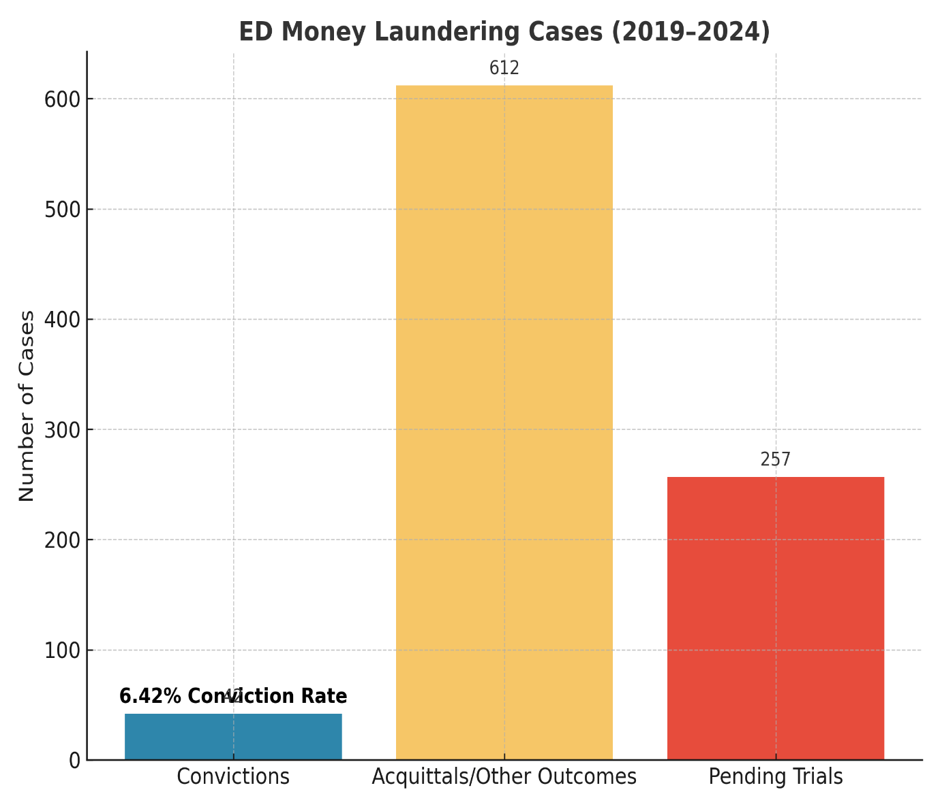
Graph-1

Graph-2
The Supreme Court has often criticised ED for its low conviction rate and poor prosecution quality. Therefore, the low conviction rate, coupled with a large number of PAOs, will only aggravate the plight of the CD by excluding the attached assets from the available asset pool for CIRP and thereby preventing a time-bound resolution.
VI. Conclusion and Way Forward
To settle the tenacious conflict between the PMLA and IBC, it is imperative to have targeted legislative amendments. Firstly, an explanation should be included in Section 14 to expressly clarify that the term “Proceedings” shall include any investigation, attachment, or enforcement under any law, i.e. civil or criminal, that affects CD’s assets, including PAO under PMLA. Secondly, a new Section 14A should be introduced to expressly bar the enforcement agencies from attaching or continuing to retain the assets of CD during CIRP, unless authorised by AA. Thirdly, Section 18 should contain an explanation mandating the enforcement agencies to cooperate with IRP or RP in taking control over the assets of CD by them. Fourthly, a new framework should be introduced for the institutionalisation of inter-agency coordination to prevent jurisdictional conflicts and ensure the integrity of PMLA and IBC.
Note: This article has been reviewed by Mr. Suharsh Sinha (Senior Partner, AZB & Partners), at the Tier II Stage.


